Expert gold project assessment and risk analysis for investors and joint ventures.

Gold Project Due Diligence & Technical Advisory

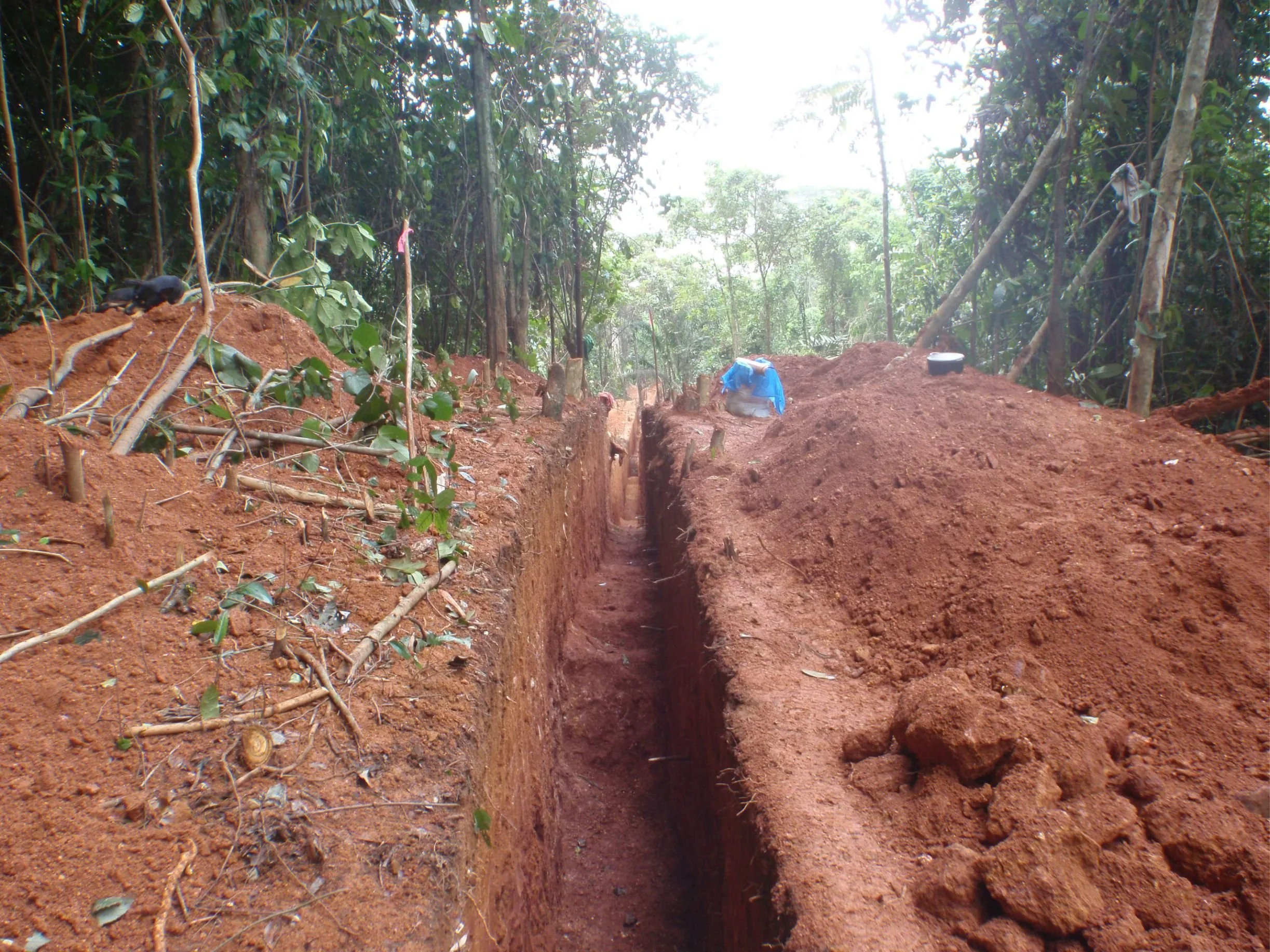
Exploration trenching program exposing a tropical laterite regolith profile for geochemical sampling. If saprolite can be reached and QAQC applied, trench channel sampling can be equal to a horizontal drill hole.

Decision-Making

Gold Project Due Diligence

Mynah Exploration conducts independent technical assessment of gold projects, technical reviews, gold exploration potential, risk assessment and acquisition support for investors, fund managers, and joint venture partners worldwide.

Laterite Terrain Expertise

Danae Voormeij, MSc, PGeo has extensive experience managing exploration programs in tropical laterite regolith — the complex, deeply weathered red soil that covers many of the world's gold belts. Few consultants worldwide possess this depth of laterite experience.

Danae has been a Qualified Person (QP) since 2007.

Field Team Mentorship

Mynah Exploration brings onsite training for your exploration geologists and field technicians in the skills of laterite ‘B’ soil geochemistry sampling, deep trenching, regolith interpretation and best practices for mineral exploration in tropical terrain. Practical, hands-on, and tailored to your geology, regolith profile, and climate setting.

3D Vein Modelling - Explicit Modelling

Hand-explicit 3D vein modelling beats automated implicit models for narrow-vein gold deposits.

  • The primary risk is mistaking a high-grade, near-surface supergene gold enrichment zone for a massive primary bedrock deposit. Over millions of years, tropical weathering dissolves and concentrates gold within the upper laterite regolith layer. If an exploration program fails to properly model this layer, initial shallow drill results can artificially inflate a project's perceived grade and scale, leading to costly, unsuccessful deeper drilling into un-enriched bedrock.

  • In tropical terrains, a standard geochemical surface anomaly can be highly deceptive due to soil migration and profile leaching. Regolith mapping identifies whether a gold anomaly is residual (right above the source), transported (moved down-slope), or a mechanical concentration. Knowing this prevents a field team from chasing "ghost" targets and ensures drill rigs are placed precisely over the actual primary structure.

  • A: A technical due diligence review de-risks an acquisition by looking past the promotional narrative. It thoroughly audits the historical data integrity, scrutinizes geological models (ensuring vein systems aren't over-extrapolated), evaluates assay protocols, and identifies specific regional risks—such as complex tropical weathering profiles or structural misinterpretations—before capital is committed.

  • A: No. Automated computer algorithms excel at mathematical interpolation but often struggle with the sharp, complex realities of structurally controlled gold and copper deposits. Hand-explicit 3D vein and structural modeling integrates real-world geological logic, ensuring that drill targets are based on genuine geometric continuity rather than digital artifacts.

Frequently Asked Questions